Cleaning machines explained – understand the differences between the models


Cleaning machines explained – understand the differences between the models
Cleaning machines have become an indispensable part of modern commercial cleaning. They save time, reduce physical strain and ensure a consistent cleaning result. But the market offers many types and models – from compact floor scrubbers to large combination machines – and it can be challenging to find the solution that best suits the company’s needs.
In this article, we review the most important factors to consider when choosing a cleaning machine and provide an overview of the most common types and manufacturers on the market.
The article presents a wide range of cleaning machines that cover different needs and price ranges. The aim is to provide an informative overview of features, capacity and areas of application so you can assess which type of machine best suits your workplace. The information is based on publicly available product descriptions from manufacturers and retailers and summarised to provide a clear basis for comparison.
Factors to consider when buying a cleaning machine
When investing in a cleaning machine, it is important to consider operation, ergonomics and cleaning results. Here are some of the key considerations.
1. Area of use and floor type
Start by assessing which areas the machine will be used on. A compact machine is ideal for offices and institutions with many pieces of furniture, while larger machines are suitable for halls, supermarkets or production areas. Also consider the floor type – smooth floors require different brushes and cleaning agents than rough or porous surfaces.
2. Capacity and operating time
Tank size and battery capacity have a major impact on efficiency. A machine with a larger water tank and long operating time can cover more square metres without interruptions. However, it may be heavier and less manoeuvrable, so the balance between capacity and flexibility is important.
3. Ease of use and ergonomics
The design and operation of the machine affect both efficiency and the working environment. Choose a model with intuitive controls, an adjustable handle and good manoeuvrability. Ergonomic solutions reduce the risk of strain injuries and make the work easier for staff.
4. Maintenance and service
A cleaning machine requires regular maintenance to function optimally. Consider how easy it is to clean tanks, brushes and filters, as well as how easy it is to obtain spare parts. Some manufacturers offer service agreements, which can be an advantage in busy operational environments.
5. Price and total economy
The price of cleaning machines varies significantly. In addition to the purchase price, you should include operating costs such as electricity consumption, cleaning agents, wear parts and service. A slightly more expensive machine with lower operating costs can often prove to be the most economical solution in the long run.
Products in focus
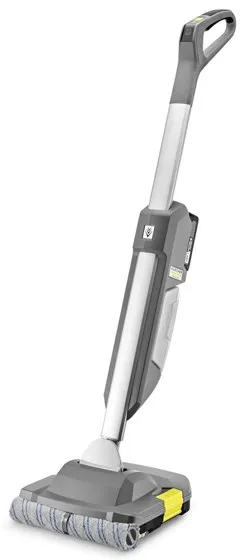
Kärcher COMPACT SCRUBBER BR 30/1 C Bp Pack 18/25 is a compact cleaning and drying machine developed to handle smaller floor areas with high efficiency. The machine has a maximum performance of 200 m² per hour and is suitable for quick cleaning of hard floors.
The battery-powered design provides great freedom of movement without the need for a power connection, and it uses an 18 V lithium-ion battery with a capacity of 2.5 Ah, providing up to 45 minutes of operating time per charge.
The machine is equipped with a brush that rotates between 500 and 650 revolutions per minute, ensuring thorough cleaning. It has separate tanks for clean and dirty water with capacities of 1 litre and 0.7 litres respectively.
With a noise level of only 55 dB, it is suitable for use in noise-sensitive environments. The compact size and low weight of 6.1 kg make it easy to transport and store, while the ergonomic design contributes to a comfortable working posture during use.
- Compact design: Easy to manoeuvre and store, ideal for smaller areas.
- Battery operation: 18 V lithium-ion battery provides up to 45 minutes of operating time.
- Efficient cleaning: Brush speed of 500–650 rpm and contact pressure up to 40 g/cm².
- Low noise level: Only 55 dB, suitable for noise-sensitive areas.
- Separate water handling: 1 L fresh water tank and 0.7 L waste water tank for efficient cleaning.
Pros and cons
- Compact and lightweight design
- Cordless operation with lithium-ion battery
- Low noise level during use
- Easy handling and transport
- Efficient cleaning of smaller floor areas
- Limited tank capacity suitable for smaller areas
- The 45-minute operating time may require recharging for larger tasks
Pros and cons
Pros
- Compact and lightweight design
- Cordless operation with lithium-ion battery
- Low noise level during use
- Easy handling and transport
- Efficient cleaning of smaller floor areas
Cons
- Limited tank capacity suitable for smaller areas
- The 45-minute operating time may require recharging for larger tasks
Pros
- Compact and lightweight design
- Cordless operation with lithium-ion battery
- Low noise level during use
- Easy handling and transport
- Efficient cleaning of smaller floor areas
Cons
- Limited tank capacity suitable for smaller areas
- The 45-minute operating time may require recharging for larger tasks
Specifications
- Manufacturer: Kärcher
- Model: 1.783-055.0
- EAN: 4054278834504
- Machine type: Step-on
- Product colour: Grey, White
- Maximum performance: 200 m²/h
- Waste water tank volume: 0.7 L
- Fresh water tank capacity: 1 L
- Brush rotation speed (min.): 500 rpm
- Brush rotation speed (max.): 650 rpm
- Brush contact pressure (max.): 40 g/cm²
- Noise level: 55 dB
- Power source: Battery
- AC input voltage: 100–240 V
- AC input frequency: 50–60 Hz
- Battery technology: Lithium-Ion (Li-Ion)
- Battery voltage: 18 V
- Battery capacity: 2.5 Ah
- Operating time: 45 min.
- Width: 305 mm
- Depth: 340 mm
- Height: 1200 mm
- Weight: 6.1 kg
- Package weight: 11 kg
Product descriptions
Kärcher COMPACT SCRUBBER BR 30/1 C Bp Pack 18/25 is a compact cleaning and drying machine developed to handle smaller floor areas with high efficiency. The machine has a maximum performance of 200 m² per hour and is suitable for quick cleaning of hard floors.
The battery-powered design provides great freedom of movement without the need for a power connection, and it uses an 18 V lithium-ion battery with a capacity of 2.5 Ah, providing up to 45 minutes of operating time per charge.
The machine is equipped with a brush that rotates between 500 and 650 revolutions per minute, ensuring thorough cleaning. It has separate tanks for clean and dirty water with capacities of 1 litre and 0.7 litres respectively.
With a noise level of only 55 dB, it is suitable for use in noise-sensitive environments. The compact size and low weight of 6.1 kg make it easy to transport and store, while the ergonomic design contributes to a comfortable working posture during use.
- Compact design: Easy to manoeuvre and store, ideal for smaller areas.
- Battery operation: 18 V lithium-ion battery provides up to 45 minutes of operating time.
- Efficient cleaning: Brush speed of 500–650 rpm and contact pressure up to 40 g/cm².
- Low noise level: Only 55 dB, suitable for noise-sensitive areas.
- Separate water handling: 1 L fresh water tank and 0.7 L waste water tank for efficient cleaning.
Pros and cons
- Compact and lightweight design
- Cordless operation with lithium-ion battery
- Low noise level during use
- Easy handling and transport
- Efficient cleaning of smaller floor areas
- Limited tank capacity suitable for smaller areas
- The 45-minute operating time may require recharging for larger tasks
Pros and cons
Pros
- Compact and lightweight design
- Cordless operation with lithium-ion battery
- Low noise level during use
- Easy handling and transport
- Efficient cleaning of smaller floor areas
Cons
- Limited tank capacity suitable for smaller areas
- The 45-minute operating time may require recharging for larger tasks
Pros
- Compact and lightweight design
- Cordless operation with lithium-ion battery
- Low noise level during use
- Easy handling and transport
- Efficient cleaning of smaller floor areas
Cons
- Limited tank capacity suitable for smaller areas
- The 45-minute operating time may require recharging for larger tasks
Specifications
- Manufacturer: Kärcher
- Model: 1.783-055.0
- EAN: 4054278834504
- Machine type: Step-on
- Product colour: Grey, White
- Maximum performance: 200 m²/h
- Waste water tank volume: 0.7 L
- Fresh water tank capacity: 1 L
- Brush rotation speed (min.): 500 rpm
- Brush rotation speed (max.): 650 rpm
- Brush contact pressure (max.): 40 g/cm²
- Noise level: 55 dB
- Power source: Battery
- AC input voltage: 100–240 V
- AC input frequency: 50–60 Hz
- Battery technology: Lithium-Ion (Li-Ion)
- Battery voltage: 18 V
- Battery capacity: 2.5 Ah
- Operating time: 45 min.
- Width: 305 mm
- Depth: 340 mm
- Height: 1200 mm
- Weight: 6.1 kg
- Package weight: 11 kg
Different types of cleaning machines
There are many types of cleaning machines, each developed for specific tasks and environments. Here is an overview of the most commonly used categories.
1. Floor scrubbers
Floor scrubbers combine brushing, washing and suction in one operation. They are available as both corded and battery-powered models and can be walk-behind or ride-on. They are ideal for larger areas where manual cleaning would be too time-consuming.
2. Sweepers
Sweepers are used for quick removal of dust, dirt and small particles. They come in both manual and motorised versions and are often used in warehouses, parking areas and outdoor spaces. They can be used as preparation before floor washing or for daily maintenance.
3. Combination machines
Combination machines combine the functions of sweepers and floor scrubbers in one unit. They can sweep, wash and dry the floor in one operation, making them particularly effective in large production environments and logistics centres.
4. Carpet cleaners
For textile-covered floors, carpet cleaners are used. They spray cleaning solution into the carpet and then extract it again along with the dirt. They are often used in hotels, offices and institutions where carpets require thorough and gentle cleaning.
5. Pressure washers
Pressure washers are used for outdoor cleaning of facades, machines and vehicles. They are available in both cold and hot versions and can effectively remove stubborn dirt, oil and algae.
Different brands of cleaning machines
The market for cleaning machines includes many manufacturers, each with their own strengths and areas of specialisation.
Nilfisk
Nilfisk is one of the best-known brands in professional cleaning. They offer a wide range of floor scrubbers, sweepers and pressure washers with a focus on reliability and ergonomics.
Kärcher
Kärcher is known for innovative solutions and user-friendly machines. The range spans from compact models to large industrial machines, and the brand is popular in both commercial and domestic settings.
Taski
Taski, part of Diversey, specialises in cleaning machines for professional environments. Their machines are known for high efficiency, low noise levels and a focus on sustainability.
Tennant
Tennant produces robust machines for demanding environments such as warehouses and production facilities. They are known for durability, effective dust control and advanced cleaning technologies.
Viper
Viper offers affordable cleaning machines with a focus on simple operation and solid quality. The brand is aimed particularly at small businesses and institutions that want reliable solutions without advanced features.
Frequently asked questions
Which type of cleaning machine is best for my business?
It depends on the size of the area, floor type and cleaning frequency. Smaller offices often manage with compact floor scrubbers, while large production areas require more powerful combination machines.
How often should a cleaning machine be used?
The frequency depends on the level of use in the area. In high-traffic environments such as shops and schools, daily cleaning may be necessary, while less busy areas can make do with weekly machine cleaning.
Do cleaning machines require special cleaning agents?
Yes, most machines work best with cleaning agents developed specifically for machine cleaning. This ensures correct foam formation and protects the machine’s components.
How do you maintain a cleaning machine?
After each use, tanks should be emptied and rinsed, and brushes and squeegees cleaned. Regular servicing and replacement of wear parts extend the machine’s lifespan and ensure good cleaning results.
Can one machine be used for both indoor and outdoor cleaning?
Some sweepers and pressure washers can be used both indoors and outdoors, but most machines are optimised for specific environments. Always check the manufacturer’s recommendations for correct use.
Læs også: